
Route overview
The Tour Aotearoa route has evolved over the years to incorporate new sections of trail and bypass closed sections. The guidebook is also revised to update the ever-changing range of services available along the route. Please do not rely on out-of-date editions of the guidebook or route files!
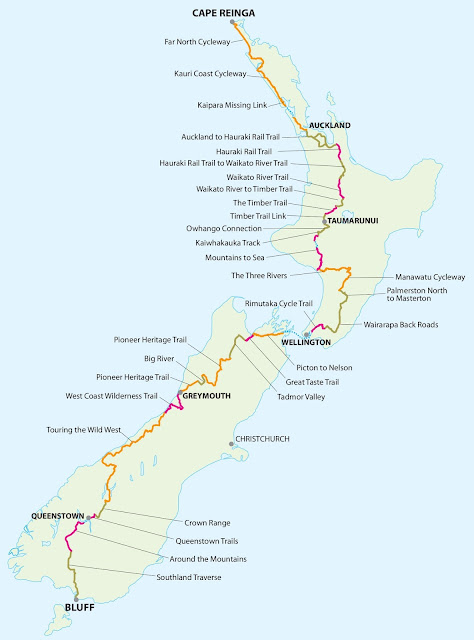
Tour Aotearoa paper guidebooks were published in 2016, 2017, 2018, 2019, 2021, 2023 and late-2025. The PDF version is updated whenever a change is needed.
Visit this Google web map [updated 22 April 2026]
Get the latest GPS downloads here.
When to start from Cape Reinga
You need to plan your start day and time when the tide on Ninety Mile Beach is low. This allows you to ride on the firm sand near the waters edge. (During high tide riders are be forced into the higher soft sand and don't enjoy the slog. It results in a demoralising first day - avoid at all costs!)
The best source for predicting the tide in advance is: https://tides.niwa.co.nz/?latitude=-34.538&longitude=172.741
You want to pick a day where low tide is about 3 hours after you start riding from Cape Reinga.
So if you plan to start at 9 am then you'll want to find a day where low tide is around 12 noon plus or minus 1 hour.
For example: The first wave of the 2024 TA Brevet is on 18 Feb starting at 7:00 am. Low tide is at 10:41 am that day. It takes between 30 and 60 minutes to ride from Cape Reinga carpark to the start of Ninety Mile Beach. That gives riders roughly 3 hours to get halfway down Ninety Mile Beach, and 6 hours to complete the beach ride before half-tide. If there's a headwind it can take longer.
The best time of year to ride the TA is: summer (warmer, longer days), after the main holiday season (easier to get accommodation). Mid to late February is optimal. Early March works. By April the days are getting shorter and colder. Early mid-December can also work if you're doing just one Island.
Avoid 23 December to mid-January - everything is booked out and over-crowded.
In winter the days are short and cold and accommodation in remote places will be closed. On the other hand... you'll get some impressive "Look how much I suffered!" photos.
Tour Aotearoa route design principles
The Tour Aotearoa route was first conceived by Jonathan Kennett in 2016 and is now reassessed every few months as trails, roads and conditions change. Some changes are sudden - like when a new section of cycle trail opens, or a road is closed, and some changes are slow burners - like when Highway 29 traffic became too much.
Here's some key principles that Jonathan and the Kennett Brothers use to choose the route:
- Cape Reinga to Bluff enjoyably
- include as many NZ Cycle Trails as makes sense
- avoid bad traffic roads (over 1000 vehicles a day) unless it's short, has a good shoulder, and serves the first principle
- include a wide range of New Zealand experiences (e.g. the middle of Auckland and West Coast Wilderness Trail)
- include cool things... and avoid "artificial" detours
- don't add hills unnecessarily... and don't avoid hills
- the first principle is the top priority.
The "enjoyability" of your ride does depend on:
- the weather
- your ability to ride a wide range of cycling terrains
- your preparation
- your adaptability (i.e. if something is not going well, can you change what you're doing?)
- the people you ride with and meet along the way.
It's a huge undertaking for any rider and a lot of things can happen. Prepare and adapt.
Some suggestions:
- focus on making your bike comfortable
- suspension (including fatter tires) increases your enjoyment
- if you are getting too tired - take a day off
- if the weather is really bad - take a day off
- if you're not enjoying your riding partner(s) - take a day away from them
- if you discover you really don't want to do it - take a day off
- if you're tired and grumpy - take a day off.
